

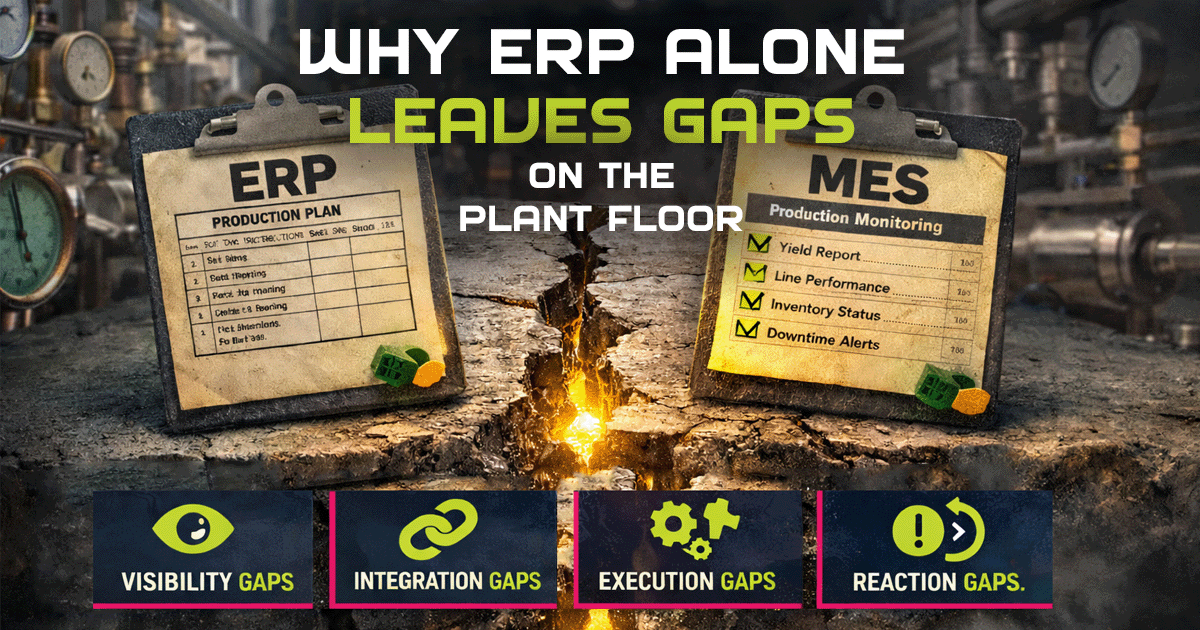
Many food manufacturers assume their ERP already handles plant-floor operations.
That assumption is understandable. ERP systems are essential to the business, and they often include production-related functions. But food manufacturing plants quickly discover that recording production activity is not the same as managing production in real-time.
When supervisors need immediate visibility into yield, traceability, labor, inventory movement, or process exceptions, ERP alone often falls short. That is where MES comes in.
ERP and MES serve different roles. One manages the business. The other helps manage execution on the plant floor.
What an ERP does well
ERP systems are designed to manage core business processes across the organization. In a food company, that often includes:
-
purchasing
-
sales orders
-
inventory valuation
-
financial reporting
-
customer data
-
planning and scheduling
-
lot records at a high level
ERP is the system of record for the business. It is essential for managing transactions, standardizing data, and connecting departments.
But ERP systems are not typically built to monitor the flow of production in real time.
They usually do not capture the level of plant-floor detail needed to answer questions such as:
-
What is our actual yield by line, shift, product, or batch right now?
-
Where is giveaway occurring?
-
Which work center is falling behind schedule?
-
Has product been scanned, weighed, labeled, and routed correctly?
-
Are we making decisions based on live conditions or yesterday’s reports?
That is where MES comes in.
What an MES does well
A Manufacturing Execution System operates closer to the production process itself. It helps manufacturers monitor, control, and optimize plant-floor activity in real-time.
In a food manufacturing plant, MES often supports areas such as:
-
production tracking
-
yield monitoring
-
giveaway control
-
work-in-process visibility
-
traceability
-
labeling and scan verification
-
downtime tracking
-
quality data collection
-
labor reporting
-
inventory movement on the floor
-
integration with equipment and shop-floor devices
MES helps bridge the gap between the production plan and what is actually happening. It turns plant activity into usable operational intelligence.
ERP vs. MES: the simplest way to think about it
A practical way to explain the difference is this:
-
ERP tells you what should happen.
-
MES shows you what is happening.
ERP manages orders, materials, and business rules. MES manages execution, exceptions, and plant-floor performance.
ERP may tell you that raw material was issued to production. MES can show you how that material was consumed, what yield it produced, where losses occurred, and whether the finished product was correctly labeled, palletized, and moved.
ERP may hold the production schedule. MES can help supervisors see whether the plant is actually staying on pace, where bottlenecks are forming, and what needs attention right now.
Why this matters so much in food manufacturing
Food manufacturing is not a simple, linear environment.
Unlike discrete manufacturing, food processors deal with variable raw materials, changing weights, quality variation, shelf-life sensitivity, sanitation requirements, and strict traceability demands. In meat, poultry, seafood, dairy, bakery, and prepared foods, real-time conditions on the floor can change quickly.
That means a system built only for transaction management is not enough.
Food manufacturers need to be able to:
-
respond to production issues as they happen
-
track losses and yield in real time
-
connect plant-floor activity to traceability records
-
improve decision making at the line, shift, and supervisor level
-
give management clearer visibility into operational performance
MES does not replace ERP. It strengthens it.
Common signs your plant may need MES visibility
Many food manufacturers already have an ERP in place but still struggle with blind spots on the plant floor.
Some common signs include:
-
supervisors are relying on spreadsheets or whiteboards to manage production
-
yield or labor reports are delayed until after the shift
-
inventory accuracy depends on manual updates
-
traceability investigations are time-consuming
-
labeling, scanning, or process verification is inconsistent
-
production teams and business systems are not working from the same version of the truth
-
decisions are being made reactively instead of in real time
If any of these sound familiar, the issue may not be your ERP. The issue may be that your ERP was never meant to do the job of MES.
The real value comes from integration
The strongest approach is not ERP or MES. It is ERP and MES together.
When integrated properly:
-
ERP provides the business context
-
MES provides the operational detail
-
leadership gets a clearer view of performance
-
plant teams get faster feedback
-
decisions improve across both the office and the floor
That is where real-time decision-making starts to create value.
Connect your plant’s intelligence gaps
Food manufacturers do not need more disconnected data. They need better visibility into what is happening in production, while there is still time to act on it.
ERP manages the business. MES closes the plant-floor gaps that hold back performance. Together, they connect business planning with real-time execution.
Want to identify opportunities for better real-time decision making on your plant floor?
Schedule a plant walk-through with our team. We’ll help you evaluate where greater visibility, faster data, and stronger execution can improve operations.